
The Word Is Alive
Have you ever read a familiar passage of Scripture—one you may have read many times before—and suddenly it seemed as though the words were speaking directly to you?
Maybe you were walking through a difficult season and a verse you had known for years suddenly brought comfort. Perhaps you were praying for direction, and a passage seemed to shine a light on exactly what you needed to do.
Or maybe you were reading your Bible when a familiar verse stopped you in your tracks and convicted your heart in a way it never had before.
The words on the page had not changed. But something happened as you read them.
That is one of the beautiful things that I love about the Word of God. The Bible is not simply an ancient book filled with historical accounts, poetry, wisdom, and instruction. God's Word is alive.
Hebrews 4:12 tells us: "For the word of God is living and powerful, and sharper than any two-edged sword..."
Those two words—living and powerful—should change the way we approach Scripture.
We aren't simply reading words. We are encountering truth that God can use to speak, teach, correct, encourage, strengthen, and transform us.
More Than Words on a Page
The Bible was written thousands of years ago, yet its truth continues to speak into circumstances we face today. Why? Because the God who gave us His Word is still alive and active.
Isaiah 40:8 reminds us: "The grass withers, the flower fades, but the word of our God stands forever."
Generations come and go. Cultures and opinions change. But God's Word does not change.
Jesus said: "Heaven and earth will pass away, but My words will by no means pass away." —Matthew 24:35
Graphe, Logos, and Rhema
As we study the Bible, it can be helpful to understand several Greek words associated with God's Word. You may have heard the terms graphe, logos, and rhema.
Although their meanings can overlap depending on how they are used in Scripture, understanding them gives us a beautiful picture of the way God has given us His truth.
Graphe — The Written Scripture
The Greek word graphe refers to Scripture or sacred writings—the written Word of God.
Second Timothy 3:16 says: “All Scripture is given by inspiration of God, and is profitable for doctrine, for reproof, for correction, for instruction in righteousness.”
The Bible is much more than human thoughts or ideas about God. Scripture is God-breathed truth. God inspired people to write His message so that we could know His truth.
When we open our Bibles, we are holding something incredibly precious—the written Word that God has given and preserved for us.
We don't have to guess what God values, what He calls sin, what He promises, or how He wants us to live. He has given us His written Word to teach us, guide us, correct us, and help us know Him.
Simply put: Graphe is God's written Word—the Scriptures we read and study.
Logos — The Message of the Word
The Greek word logos means word, message, or communication. In the Bible, logos can refer to God's message, but it is also used in a very special way to describe Jesus Christ.
John begins his Gospel by saying:
“In the beginning was the Word, and the Word was with God, and the Word was God.”
—John 1:1
A few verses later, John explains:
“And the Word became flesh and dwelt among us...”
—John 1:14
Jesus is the living Word. He perfectly reveals who God is.
The written Scriptures continually point us toward Jesus. As we study God's Word, we learn more about God's character, His heart, His promises, and His purposes. Ultimately, God's Word helps us know God more deeply.
Simply put: Logos speaks of the message of God’s Word and, in John 1, specifically identifies Jesus as the living Word.
Rhema — The Specific Word
The Greek word rhema generally means a specific word, saying, or utterance.
Romans 10:17 says: “So then faith comes by hearing, and hearing by the word of God.”
Sometimes we can read a Scripture that we have read many times before, but suddenly it seems especially meaningful for what we are going through.
The Holy Spirit can bring a Scripture to our remembrance at just the right moment. He may use God's Word to encourage us, correct us, strengthen our faith, give us wisdom, or remind us of God's promises.
Simply put: Rhema is a spoken or specific Word from Scripture that the Holy Spirit uses to speak truth directly into the circumstances we are facing.
The Spirit of God and the Word of God work together. We have His written Word to read and study, Jesus who perfectly reveals the Father, and the Holy Spirit who helps us understand and apply God's truth to our lives.
Jesus told His disciples: "But the Helper, the Holy Spirit...will teach you all things, and bring to your remembrance all things that I said to you."
—John 14:26
This is one reason we should never assume that because we have read a passage before, there is nothing more for us to receive from it.
Keep reading. Keep studying. Keep listening. Keep asking the Holy Spirit to help you understand.
God's Word Accomplishes Something
God's Word isn't only alive; it is active.
God said through the prophet Isaiah: "So shall My word be that goes forth from My mouth; it shall not return to Me void, but it shall accomplish what I please..."
—Isaiah 55:11
God's Word produces something in us when we receive it.
It can expose what is hidden. It can correct wrong thinking.
It can strengthen weak faith.
It can comfort a grieving heart.
It can give wisdom when we don't know what to do.
It can remind us who God is when our circumstances tempt us to doubt Him.
It can confront sin.
It can renew our minds. It can give us hope. It can change us.
There is an important difference between simply having access to God's Word and allowing God's Word to take root in our lives.
Don't Just Read It—Receive It
Many of us own several Bibles. We may have Bible apps on our phones and access to Scripture anytime we want it. But having the Word nearby is not the same as having the Word within us.
James tells us: "But be doers of the word, and not hearers only...—James 1:22
God doesn't want His Word simply to pass before our eyes. He wants it to settle into our hearts and affect the way we think, speak, respond, choose, forgive, love, pray, and live.
That requires more than occasionally reading a verse.
We need to slow down as we are reading God’s Word.
Read it. Think about it. Meditate on it. Pray over it. Obey it.
And remember it.
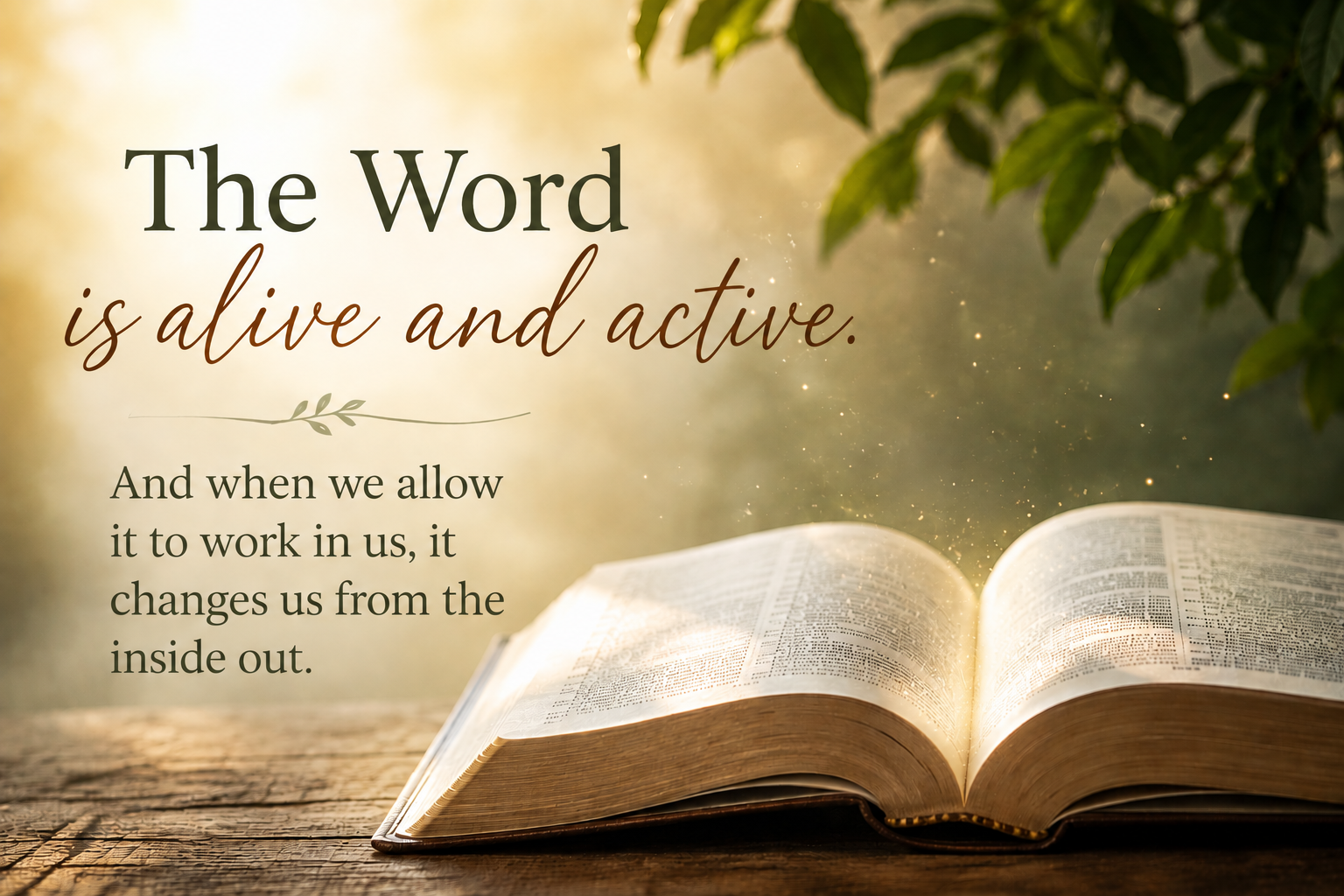
Since God’s Word truly is living and powerful, perhaps the question isn’t simply, “Am I reading my Bible?” Maybe we also need to ask a deeper question:
What am I allowing God’s Word to do in me?”
Is it changing the way I think?
Is it correcting me when I’m wrong?
Is it strengthening me when I’m weak?
Is it shaping the decisions I make?
Is it changing the way I respond to others?
Is it increasing my faith?
Is it drawing me closer to Jesus?
Because God’s Word was never meant to simply be words we read on a page. It is meant to take root in our hearts, transform our thinking, guide our steps, and change the way we live.
David wrote: "Your word I have hidden in my heart, that I might not sin against You."
—Psalm 119:11
That leads us to an important spiritual discipline that sometimes gets overlooked: Scripture memorization.
God’s Word is worth more than an occasional reading.
It is worth remembering. It is worth carrying with us.
And it is worth hiding deep within our hearts.
In the next post, Hiding His Word in My Heart, we'll look at why Scripture memorization matters and explore practical ways to make God's Word part of our everyday lives.
Prayer:
Father, thank You for the gift of Your Word. Thank You that it is living, powerful, and still speaking into our lives today. Give me a heart that doesn’t simply read Your Word, but receives it, treasures it, and allows it to change me from the inside out.
Holy Spirit, help me understand Your truth and live it out each day. Let Your Word take root deep within my heart, strengthen my faith, shape my life, and produce fruit that reflects Jesus to those around me.
In Jesus’ name, Amen.